

Uncategorized

Lighting Control Module: The Core of Modern Lighting Control Systems for Smart Living

In the era of smart homes, lighting has evolved from a simple tool for providing brightness into a vital part of smart space management. Among the numerous technologies driving this transformation, an unsung hero stands out: a core electronic component that serves as a bridge linking basic lighting control, remote operation, and comprehensive control systems. It quietly reshapes how we interact with lights in homes, offices, and commercial spaces. Whether you’re adjusting bedroom lights via a mobile app or a shopping mall automatically dimming corridor lighting at night, this key component is likely working behind the scenes. This article will delve into what this module is, its role in various lighting control scenarios, and how it integrates with smart home setups to create efficient, convenient, and personalized lighting experiences.

I. Core Definition: What is This Key Lighting Component?

Let’s start with the fundamental question: What is a lighting control module? Essentially, it is a core electronic component integrated with microprocessors, communication interfaces, and control circuits, designed to centrally manage and regulate lighting devices. Unlike traditional manual switches that only enable simple on-off operations, this component can process complex instructions, collaborate with sensors and remote terminals, and implement diverse functions such as dimming, color adjustment, timing control, and group management.
 
Its hardware structure typically includes a microcontroller unit (MCU) responsible for instruction processing, a communication module supporting Wi-Fi, ZigBee, or RS-485 protocols, and an output control unit that drives the operation of lighting equipment. For example, the LC-101H model launched by ICP DAS not only supports on-off control of lighting circuits via RS-485 communication but also monitors load current in real time, helping users detect faulty lights promptly. This integration of control and monitoring capabilities makes it the cornerstone of modern lighting control systems, breaking the limitations of traditional lighting.

II. Remote Lighting Control: The Convenience Breakthrough of Intelligent Modules

One of the most well-known advantages of this core component is its strong support for remote lighting control. Before the popularization of remote operation, people often faced trivial annoyances—forgetting to turn off living room lights when going out or having to get up in the middle of the night to adjust bedroom lighting. This intelligent module perfectly solves these problems by integrating wireless communication technologies.
 
Its working principle for remote control is straightforward: when a user sends a command (such as turning off a light) via a mobile app or remote control, the signal is transmitted to the module through Wi-Fi, Bluetooth, or radio frequency (RF) technology. After the component decodes and processes the signal, it drives the internal relay to act, thereby controlling the state of the lighting device. Unlike infrared remote control that requires line-of-sight operation, the remote control supported by this module can penetrate walls and obstacles. For instance, when you’re on your way to work, you can send an instruction to your home module via your smartphone to immediately turn off the forgotten kitchen light. This seamless remote control experience is precisely the convenience that this component brings to daily life, greatly enhancing the ease of lighting management.
展示不同场景的照明控制 1

III. Smart Home Linkage: Creating Personalized Scene Lighting Experiences

Beyond simple remote control, this core component excels at creating personalized scene modes through integration with smart home lighting systems. In modern smart homes, it is no longer an independent component but a key node connecting the entire smart ecosystem. It can collaborate with other smart devices to achieve linked control and build various scene modes that meet different lifestyle needs.
 
For example, setting a “Leisure Mode” on the smart home panel will send an instruction to the module. The component will then dim the living room lights to 30% brightness, adjust the color temperature to warm yellow, and simultaneously link with the curtain control system to close the curtains slowly. When the home security system detects an abnormal intrusion, it can also send an alarm signal to the module, which will immediately turn on all lights in the house to deter intruders. Lutron, a leader in the smart lighting industry, has designed such modules compatible with over 1,000 types of dimmable bulbs. These components can be integrated into its Caséta or RadioRA 3 systems to achieve whole-home lighting control and support linkage with thermostats and other devices. This integrated design transforms smart home lighting control from a single-device operation into a systematic service that adapts to users’ daily rhythms.

IV. Commercial and Office Scenarios: The Energy-Saving and Management Value of Intelligent Components
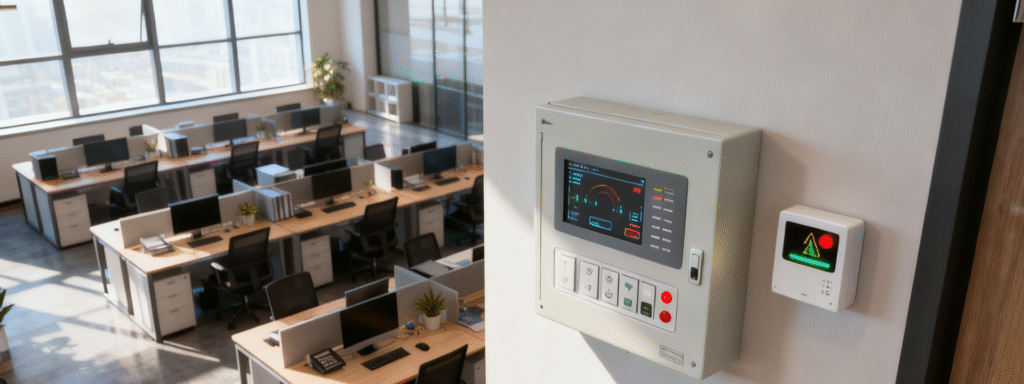
In commercial and office environments, this core module plays an irreplaceable role in optimizing lighting control systems and reducing energy consumption. These spaces typically have large lighting areas and complex lighting needs. Simple manual control not only consumes significant manpower but also easily leads to energy waste due to oversight. This intelligent component addresses these issues through its management capabilities.
 
It can connect with photosensitive sensors and human infrared sensors to implement “lights on when people are present, lights off when people leave” and adaptive brightness adjustment. For example, in an office building, when the photosensitive sensor detects sufficient natural light outdoors at noon, it will transmit data to the module, which will then automatically dim indoor lights or turn off some non-essential lighting. In a large conference room, the component can group lights by different areas—turning on lights above the podium and off in the audience area during speeches, and turning on all lights during group discussions to ensure a bright communication environment. Additionally, the module can record and analyze lighting energy consumption data. Managers can check energy usage in each area through the backend and promptly adjust lighting strategies via the component if abnormal energy consumption is detected, providing data support for energy-saving renovations in commercial spaces.
展示不同场景的照明控制

V. Installation and Expansion: The Scene Adaptability Advantages of These Modules

This core component also exhibits strong adaptability in terms of installation and expansion, which is one of the key reasons for its widespread application in various scenarios. Whether it’s a new house under renovation or an old house requiring smart upgrades, this module can provide flexible solutions.
 
For new buildings, the component can be pre-installed in the electrical system during the construction phase, with unified wiring planning to lay the foundation for subsequent whole-home lighting control systems. For old houses, most wireless modules on the market do not require complex wiring modifications. They only need to be connected in series to the lamp circuit and then paired with a mobile app to achieve remote control and intelligent transformation at a low cost. Furthermore, many such components adopt a modular design, allowing users to expand functions according to their needs. For example, Eaton’s LCMB12WB model can add a communication bus interface when needed to connect with larger-scale lighting control systems. If dimming functionality is required later, it can be upgraded to the LCMB12WDB model with dimming capabilities. This scalable design not only reduces users’ initial investment costs but also enables the lighting control system to keep pace with technological upgrades, avoiding waste caused by overall equipment replacement.

VI. Energy Conservation and Environmental Protection: The Core Practical Value of These Components

When it comes to the practical value of this module, its contribution to energy conservation and environmental protection cannot be ignored. In today’s society where green development is a consensus, reducing unnecessary energy consumption has become a common goal for families and enterprises. This intelligent component achieves precise energy management of lighting systems through various strategies, significantly reducing energy waste.
 
On one hand, it avoids the phenomenon of “lights staying on when no one is around” by linking with human body sensors. For example, in public areas such as corridors and stairwells of residential buildings, the module turns on lights only when the sensor detects someone passing by and automatically turns them off after a delay—much more energy-efficient than traditional 24/7 lighting. On the other hand, the component can implement timing control based on usage habits. For instance, shopping malls can set the module to turn on sign lights at 7 PM and off at midnight, while office buildings can let the component uniformly turn off all office lights at 8 PM. Additionally, the module can adjust lighting power according to electricity prices during different periods—appropriately increasing brightness during off-peak hours and reducing brightness or shortening lighting time during peak hours—to lower electricity costs while saving energy. Relevant data shows that the application of such components in commercial buildings can reduce lighting energy consumption by 30%-50%, achieving remarkable energy-saving effects.

VII. Common Issues and Solutions: A User Guide for These Modules

Like other smart devices, this core component may encounter some common issues during use, but most can be resolved through simple operations. One of the most common problems is the failure of remote control, which may be due to the module being disconnected from the network or mismatched communication protocols.
 
In this case, users can first check if the Wi-Fi or ZigBee signal is stable. If the signal is weak, they can move the router closer to the component or add a signal booster. Another scenario is the module failing to respond to sensor instructions, which may be caused by incorrect sensor parameter settings (e.g., the human body sensor’s sensitivity is too low to detect movement). Users can adjust the parameters via the app to resolve the issue. Additionally, some users worry that the component consumes extra power when on standby. In fact, the standby power consumption of most modules on the market is only a few watts, negligible compared to the energy saved through the component’s intelligent control. For long-term use, it is recommended that users regularly check the module’s working status via the app and install firmware updates in a timely manner to ensure stability and security.

VIII. Future Trends: Intelligent Modules Empowered by AI and IoT

Looking ahead, with the development of technologies such as the Internet of Things (IoT) and artificial intelligence (AI), these core components will usher in more technological innovations and broader application scenarios. In terms of AI integration, future modules will have learning capabilities—able to record users’ daily lighting habits (e.g., the time to turn on bedroom lights in the morning or the preferred brightness for reading at night) and automatically adjust lighting status without manual settings.
 
For example, if a user usually dims the living room lights to 20% at 10 PM every day, the module will learn this habit and complete the adjustment automatically at the specified time. In terms of IoT, these components will connect to larger-scale IoT platforms to achieve cross-space management. For instance, managers of chain stores can centrally control the lighting of all stores through a cloud platform, sending uniform instructions to each store’s module to ensure consistent lighting styles across all locations and improve management efficiency. Additionally, with the development of green energy, these components may integrate with solar power generation systems—prioritizing solar energy for lighting based on the power output of solar panels and storing excess energy to further enhance the energy-saving and environmental protection properties of lighting systems.

IX. Conclusion: The Core Cornerstone of Modern Lighting Control

From basic on-off control to complex smart linkage, the lighting control module has become an indispensable core component in modern lighting control systems. It not only simplifies the operation of remote and smart home lighting control but also injects new vitality into energy-saving management in commercial and public spaces. Whether you’re a homeowner pursuing a smart lifestyle, a designer creating commercial spaces, or a manager focusing on energy efficiency, understanding and applying this module can bring unexpected benefits.
 
As technology continues to advance, these intelligent components will undoubtedly become more integrated, creating more comfortable, efficient, and environmentally friendly lighting environments for people. On the journey of intelligent transformation, the lighting control module will always be the solid cornerstone supporting the development of lighting control technology.

发表回复

您的邮箱地址不会被公开。 必填项已用 * 标注